
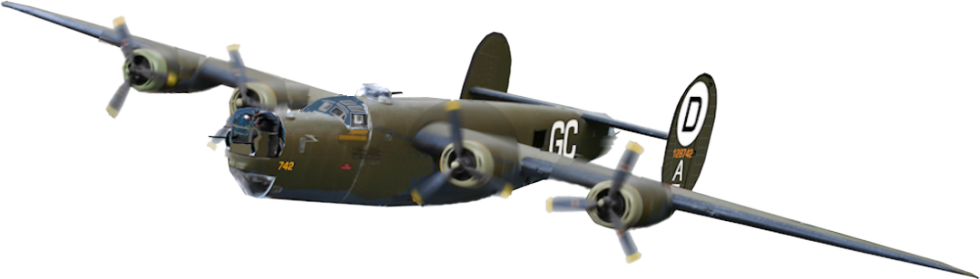
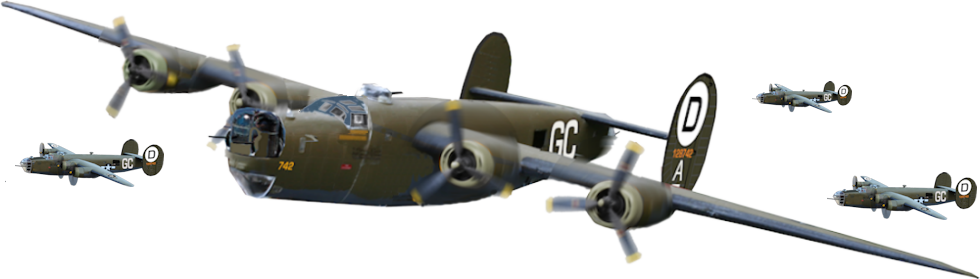
The 2nd Air Division was one of the three heavy bomber divisions of the 8th Air Force during World War II. It was the primary B-24 Liberator formation of the 8th Air Force and played a major role in the Allied strategic bombing campaign against Nazi Germany from bases in eastern England. The division originated in October 1942 as the 2nd Bombardment Wing, created as the 8th Air Force rapidly expanded its heavy bomber force in Britain. In September 1943, the wing was reorganized and redesignated the 2nd Air Division.
Unlike the other two 8th Air Force bomber divisions which flew the Boeing B?17 Flying Fortress, the 2nd Air Division was equipped primarily with the Consolidated B?24 Liberator, leveraging the greater range, speed and bomb load of the B-24 over that of the B-17.
The 2nd Air Division was headquartered in Norfolk and Suffolk, where a network of American airfields housed its bomb groups. At its peak in 1944, the division controlled 14 heavy bombardment groups and 5 fighter groups. The first operational group was the 44th Bombardment Group, which arrived in late 1942.
The 2nd Air Division began combat operations in late 1942, striking targets in German-occupied Europe. Early missions focused on submarine bases along the French coast, shipyards, port facilities, aircraft factories and a variety of industrial targets. These operations were part of the Allied Combined Bomber Offensive, which were focused on destruction of German industrial capacity through daylight precision bombing.
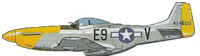
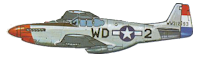
As the 8th Air Force expanded in 1943, the 2nd Air Division became a major component of the strategic bombing effort. Its B-24 groups attacked targets deep inside Germany, including aircraft production facilities, ball-bearing factories, transportation networks and oil refineries. Before long-range fighter escorts became available, these missions were extremely dangerous. German interceptors from the Luftwaffe and heavy anti-aircraft fire inflicted heavy losses on bomber formations. The division suffered severe losses during missions such as the Second Schweinfurt-Regensburg Mission attacks on German industrial centers in 1943-1944. Losses were sometimes 20-25% of attacking aircraft, far above sustainable levels. The situation improved in 1944 with the arrival of long-range escort fighters such as the North American P?51 Mustang and Republic P?47 Thunderbolt, which could accompany bombers all the way to German targets.
The 2nd Air Division played a significant role in a number of major WWII Campaigns. Big Week took place in February 1944, and the division participated in a concentrated series of attacks on German aircraft factories intended to cripple the Luftwaffe. During the spring of 1944, 2nd Air Division bombers engaged in the preparation for the D-Day Normandy landings by targeted rail lines, airfields, and coastal defenses in France. From late 1944 into 1945, the division supported Oil and Transportation campaigns by focusing heavily on destroying Germany's fuel production and transportation networks, attacks that severely weakened the German war economy.
By early 1945, German air defenses had weakened significantly. The 2nd Air Division continued bombing strategic targets until Germany surrendered in May 1945, marking the end of the war in Europe. After the end of the war in Europe, the division's units returned to the United States and were gradually inactivated as the wartime structure of the U.S. Army Air Forces was dismantled.

BOMB/FIGHTER GROUP HISTORIES
The histories of the Bomb/Fighter groups were assembled from Artificial Intelligence (AI) queries and publicly available material searched from selected internet sites related to the 8th US Army Air Force and 2nd Air Division groups. These histories were developed to provide an overview of the operational period of the bomb/fighter groups of the 2nd Air Division from the time of entry into the European Theatre of Operations (ETO) through Victory in Europe (VE) Day.
Each history contains an overview of the group missions, the squadrons which make up the group, the stations (bases) used initially in the USA and up to VE Day in the ETO, identification of commanding officers, the campaigns in which the group participated, unit/group citations and awards, and a link to currently known websites of the group memorial associations.
My father never talked much about his time in the service. I've only relatively recently come to understand he was part of the 2nd Air Division of the 8th US Army Air Force during 1944. I've always felt somewhat of a void in me because I had never served my country in the armed forces. I very much appreciated this opportunity to do something (even as small as it is) to perpetuate and honor those who served from the Greatest Generation.
I feel we certainly owe a debt of grateful remembrance to all those who served, but most of all to those who made the ultimate sacrifice. My father returned to the USA after completing 35 combat missions and went on to live a blessed and fulfilled life. Those honored in this book did not have that opportunity.
John Jurczak
Pittsburgh, Pennsylvania
THE FIGHTER AND BOMB GROUP HONOR ROLLS
In early 2005, Belton Wolf, an 8th Air Force Historical Society board member, learned that St Paul's Cathedral in London was interested in digitizing its Roll of Honor. In order to facilitate this, the 8thAFHS voted to fund the digitization. Belton Wolf soon after left the 8thAFHS board, and I was then designated to provide oversight of the disbursement of funds and be the "point person" for the 8thAFHS to St Paul's Cathedral.
I found out in 2008 that the pages were not digitized but only JPG images; in addition, many of the names were from other armed services branches mixed in with the 8th AAF names.
Several of us, from the 392nd Bomb Group Memorial Association, researched for over a year trying to find the original or copies of documents used to publish the original Roll of Honor at St. Paul's that was commissioned by President Eisenhower.
We were finally able to acquire paper copies of St. Paul's Roll of Honor at the National Army Museum in Carlisle, PA, through one of our group's connections with the Pentagon. I had connections with the chaplain at the Atmore, Alabama state prison, and he agreed to have a few select inmates digitize each of the over 22,000 only 8thAAF names, with several other inmates double-checking the accuracy of the resulting data into an Excel file.
It was this list that I used to publish the 8th Air Force Roll of Honor, along with a stand that the 8th Air Force Historical Society used to place the 8thAF Honor Rolls in over 25 libraries and museums throughout the United States and Europe. This list was the primary source from which the National Museum of the Mighty Eighth Air Force in Pooler, Ga. obtained its initial Roll of Honor. Since then, they have added names from other sources, which I also used.
Following the rededication of the Norwich, England, American Library's 2nd Air Division Roll of Honor on September 28, 2021, I began reviewing the names of the 392nd Bomb Group and found 62 names missing. Since I feel we owe a debt of grateful remembrance to those who made the ultimate sacrifice, I reviewed the other Second Air Division bomb and fighter group roll of honor sources. I found similar omissions along with countless spelling errors.
With the encouragement of several Second Air Division friends, I began the process of cataloging the missing names, correcting misspellings, and adding group affiliation and the date of death. The American Library and the Mighty Eighth Museum provided the initial primary information. The research I used for obtaining, comparing, correcting, and documenting is as follows:
St Paul's Roll of Honor, London, England
American Library in Norwich, England
Mighty Eighth Museum in Pooler, GA
Bomber and fighter group associationsv
American Air Museum in Britain
National Archives, Washington, D.C.
Fold3.com casualty listings and MACRs
Findagrave.com website
Bits and Pieces Combat Chronology
Bits and Pieces Roll of Honor
HonorStates.org website
2nd Air Division Researchers
Special thanks to James Clarey, Chris Clark, Bill Curtis, Skye James, Harold Jansen, Brian Mahoney, John McCarnish, Tim McCann, Riccard Parsonson, Vivian Rogers-Price, Marjorie Shiers, Mara Truslow, and several others who helped me identify the names and complete the Eighth Army Air Force Second Division Roll of Honor. The completed listings contain an additional 736 names of those who made the ultimate sacrifice with the 2nd Air Division that are not currently on the Norwich American Library Roll of Honor. I have also added the recorded date of death and the bomb or fighter group they were with.
There are many different requirements to be on a particular Roll of Honor. Some list only combat-related deaths, some include accidental deaths, and some only while stationed in England or a particular group. This Roll of Honor here includes any death in the line of duty, combat-related or not, while serving in a Second Division bomb or fighter group during WWII.
I have exhausted all of my resources to make this Honor Roll as complete as I possibly could. As is all the Roll of Honors of WWII and records of WWII that I have gleaned and harvested names from, none have been perfect.
My listing of names is most likely to have some errors and omissions. Hopefully, in the future, other researchers will find these errors and omissions and record them for their proper remembrance.
I've dedidacated my research and efforts to presserve the history of the Second Air Division to my father, 1Lt Dallas O. Books, KIA March 18, 1944 a pilot with the 392nd BG.Bob Books
Pensacola, Florida